
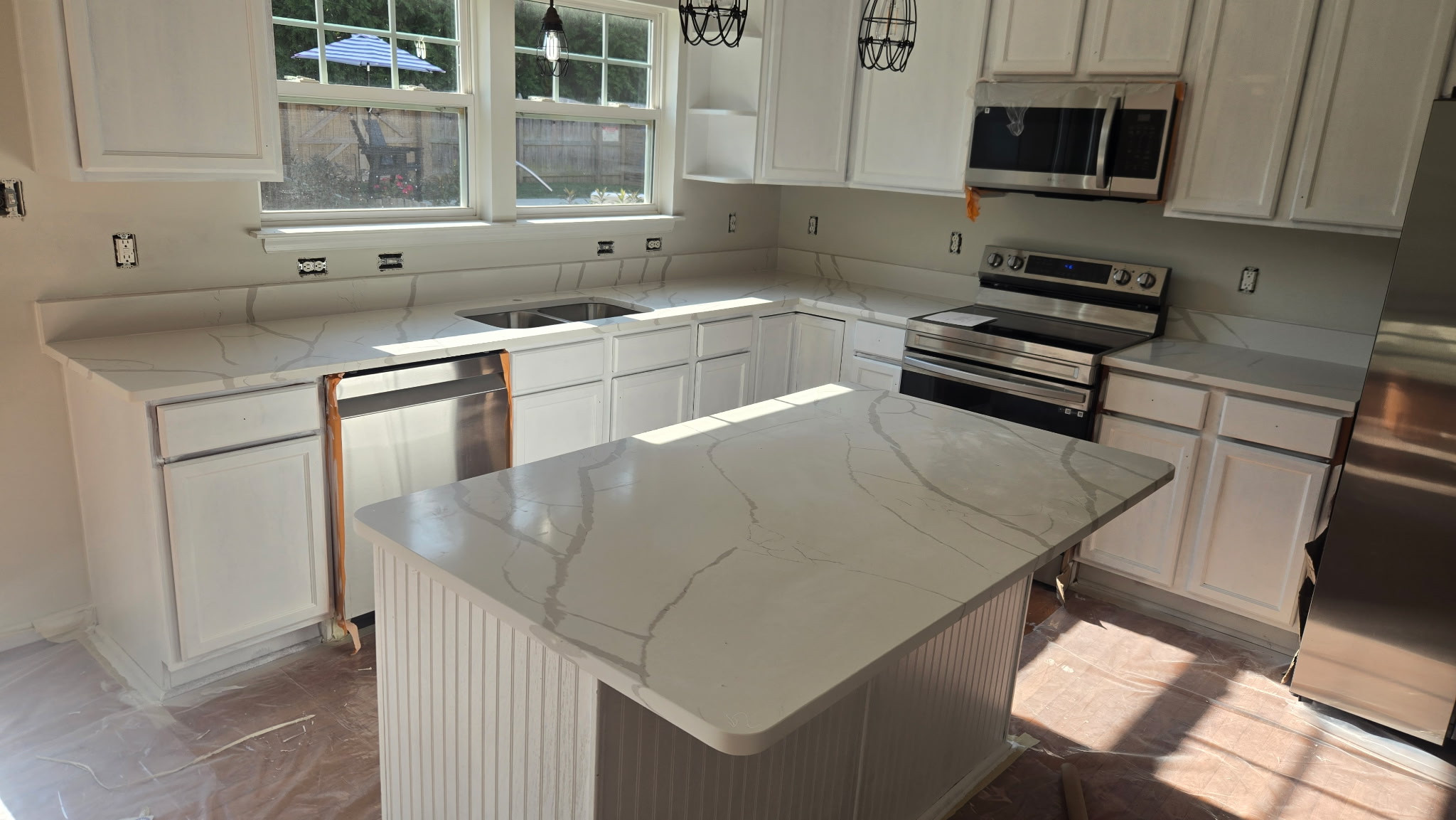
A great countertop should feel thoughtfully planned from one end of the kitchen to the other. But stone and engineered quartz are supplied in slabs of limited dimensions, and many layouts need more than one piece. That means countertop seams are a normal part of some installations—not automatically a sign of poor quality. What matters is how the seam is planned, supported, aligned and finished.
Countertop seams can usually be made neat and less noticeable, but they should never be described as completely invisible. Ask your fabricator to review the proposed seam locations and the actual slab pattern before cutting begins.
Why do some countertops need seams?
Quartz, granite, quartzite and marble slabs are not limitless in size. A long run of cabinets, a large island, an L-shaped kitchen or a layout with several cutouts may require separate sections that are joined during installation. Doorways, stairs and safe material handling can also influence how pieces are divided.
Slab dimensions are only one part of the decision. The usable area after trimming, the direction of the pattern, edge details, sink and cooktop cutouts, and the support under the countertop can all affect the fabrication plan. A bigger slab does not automatically guarantee a seam-free result.
As you compare stones, start with Granite System’s MSI Q quartz collection, granite levels or natural quartzite collection. Treat online slab photos as selection references; review actual slab dimensions and availability for your project.
Where should a countertop seam go?
There is no single ideal seam location for every kitchen. A fabricator balances visual appearance with structural support, slab yield, cutouts and the manufacturer’s installation requirements. Discuss these four factors during planning:
1. A supported joint
A seam needs an appropriate underlying support condition. The exact location is assessed against the cabinet layout, material and fabrication method.
2. Sink and cooktop cutouts
Openings create narrower areas of material. Their proximity to a seam needs careful review; do not assume that any proposed location near a cutout is automatically acceptable.
3. Sightlines and natural breaks
Some joints are less noticeable where a layout changes direction or where the pattern is visually quieter. The highest-visibility surface is not always the best place for a joint.
4. Pattern direction
Bold veining can make even a well-finished joint more obvious if the movement changes abruptly from one piece to the next.
For a U-shaped or L-shaped kitchen, ask whether a seam at a corner makes sense for the particular material. For a wide island, ask whether the selected slab will cover the full footprint and overhangs after all fabrication allowances are considered.
How visible are quartz or granite countertop seams?
A well-executed seam should look intentional and feel aligned, but it will generally remain detectable on close inspection. Visibility depends on the background color, movement of the stone, finish, lighting, and the shade of the seam-filling material. Solid or very uniform surfaces can make a line easier to notice; a busier pattern may help it blend in. Neither is a guarantee.
For engineered quartz, MSI’s installation guidance specifically notes that seams are visible and recommends inspecting slabs for color consistency before fabrication. Using adhesive tinted to the surrounding surface can help reduce contrast, but it cannot recreate a continuous printed or natural vein across a joint.

Vein matching is not the same as an invisible seam
With dramatic marble-look quartz or natural quartzite, the planning conversation should include how the slabs will be oriented and which parts of the pattern meet at the joint. A bookmatched layout uses mirror-like slab patterns where available; it is a design technique, not a promise that a joint disappears. Some colors, slab lots and room layouts will not support the look you have in mind.
If vein continuity is important, ask to review the proposed cut layout before fabrication. A pattern-driven layout can use more material and may affect the final quote.
Quartz vs. granite vs. quartzite: does seam planning change?
| Surface | What to pay attention to | What to ask |
|---|---|---|
| Engineered quartz | Repeatable designs may still vary by batch, slab and pattern direction; seams remain visible. | Have the selected slabs been checked together for color and vein alignment? |
| Granite | Each natural slab has its own mineral movement, speckling and shade variation. | Can I see how the specific pieces will meet? |
| Natural quartzite | Large flowing veins and strong variation can make layout planning especially important. | Which part of the actual slab will be used on the island and at the joints? |
Regardless of material, a finished seam depends on the complete project: layout, support, fabrication, installation, and the individual stone or surface selected.
What about oversized islands and waterfall edges?
A large island often becomes the focal point of the room, so homeowners understandably want fewer visual interruptions. Whether a single slab can cover it depends on the required finished dimensions, safe transport and installation access, edge details and the material’s usable dimensions.
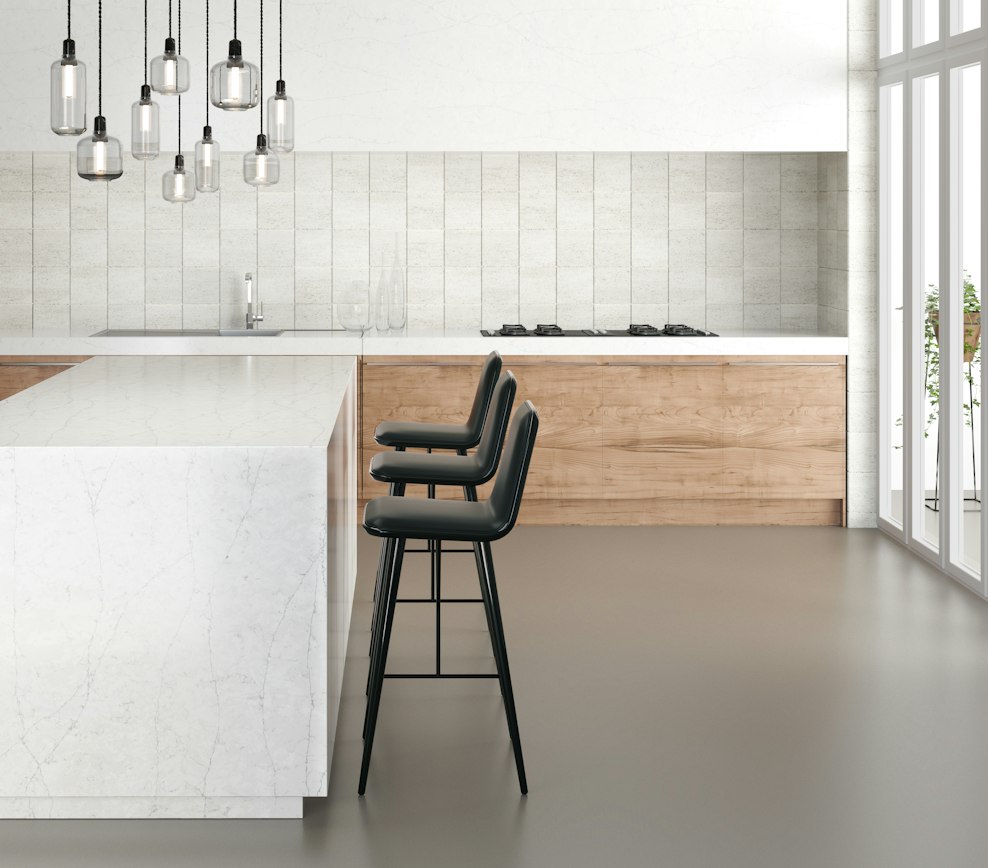
Waterfall sides introduce another visual transition where the horizontal countertop meets a vertical panel. A carefully planned pattern can create a beautiful sense of flow, but corners and mitered edges are still physical joints. Ask about the edge construction and visual mockup rather than assuming any waterfall is seamless.
Seven questions to ask before your countertop is fabricated
- How many seams are proposed, and exactly where? Request a marked layout or shop drawing.
- Why were those locations chosen? Ask about support, cutouts and material limitations.
- Will the island need a joint? Confirm with the actual slab dimensions, not just a sample.
- Can I review the slab layout? This is especially valuable for granite and expressive quartzite.
- How will color and veins meet? Discuss realistic pattern matching and expectations.
- Is a different layout possible? Ask whether the alternative affects waste, fabrication or cost.
- What will the finished seam look and feel like? Review the installation and finish expectations before approving the plan.
Granite System’s countertop price calculator is a useful early planning tool, but a preliminary estimate does not determine the number or location of seams. Those details belong in the project-specific measurement and fabrication review.
Countertop seam FAQs
Can a countertop seam be completely invisible?
No seam should be promised as invisible. Good planning, careful alignment and color-coordinated filler can make it less noticeable, but the joint may still be seen or felt.
Can I request a kitchen island without a seam?
Yes, you can ask. Whether it is feasible depends on the island dimensions, selected slab, pattern, access and safe installation requirements. Your fabricator can explain the tradeoffs before cutting.
Are seams a problem in quartz countertops?
Not by themselves. Engineered quartz slabs have size limits, and seams are a normal construction detail. Placement, alignment and finish should follow the selected product’s installation guidance.
Is it okay to have a seam near a sink?
It depends on the material, cutout geometry, support and manufacturer’s requirements. Ask the fabricator to explain the specific proposed location and how the cutout and joint will be supported.
Can veining be perfectly matched from one slab to another?
Sometimes a close visual match is possible, but never assume an exact continuation. Natural slabs vary, and engineered patterns can change across pieces. Review the actual layout for prominent veins.
What if a finished seam looks uneven?
Document the condition and contact your installer. Noticeable height differences, gaps or a change after installation deserve a professional assessment; avoid attempting structural repairs yourself.
Additional reading: MSI surface installation guidance. This article is general homeowner planning guidance; final seam placement, fabrication and support details should be verified for your specific project and chosen material.
8 Comments.
[…] happens to the pattern on either side. Digital printing does not make every joint disappear. Our countertop seam guide explains the planning […]
[…] seams early. Room dimensions, usable slab area, access and cutouts affect the plan. Our countertop seam guide explains the questions to […]
[…] our countertop seam guide for the practical questions. Confirm actual slab dimensions and usable area with the fabricator […]
[…] a considered layout. Discuss usable slab area, seams, supports, cutouts and access to the room. Our seam planning guide can help you […]
[…] the layout before fabrication rather than expecting a room photograph to predict every cut. Our countertop seam guide explains the key […]
[…] countertop seam guide explains what to ask. Confirm usable slab dimensions and the access route for a large piece; a […]
[…] attention. Review seam positions, cutouts, supports and usable slab area before fabrication. Our countertop seam guide explains the questions, and the price calculator can help start a project […]
[…] countertop seam guide can help you prepare. A striking vein is an opportunity to plan carefully, not a guarantee that […]