
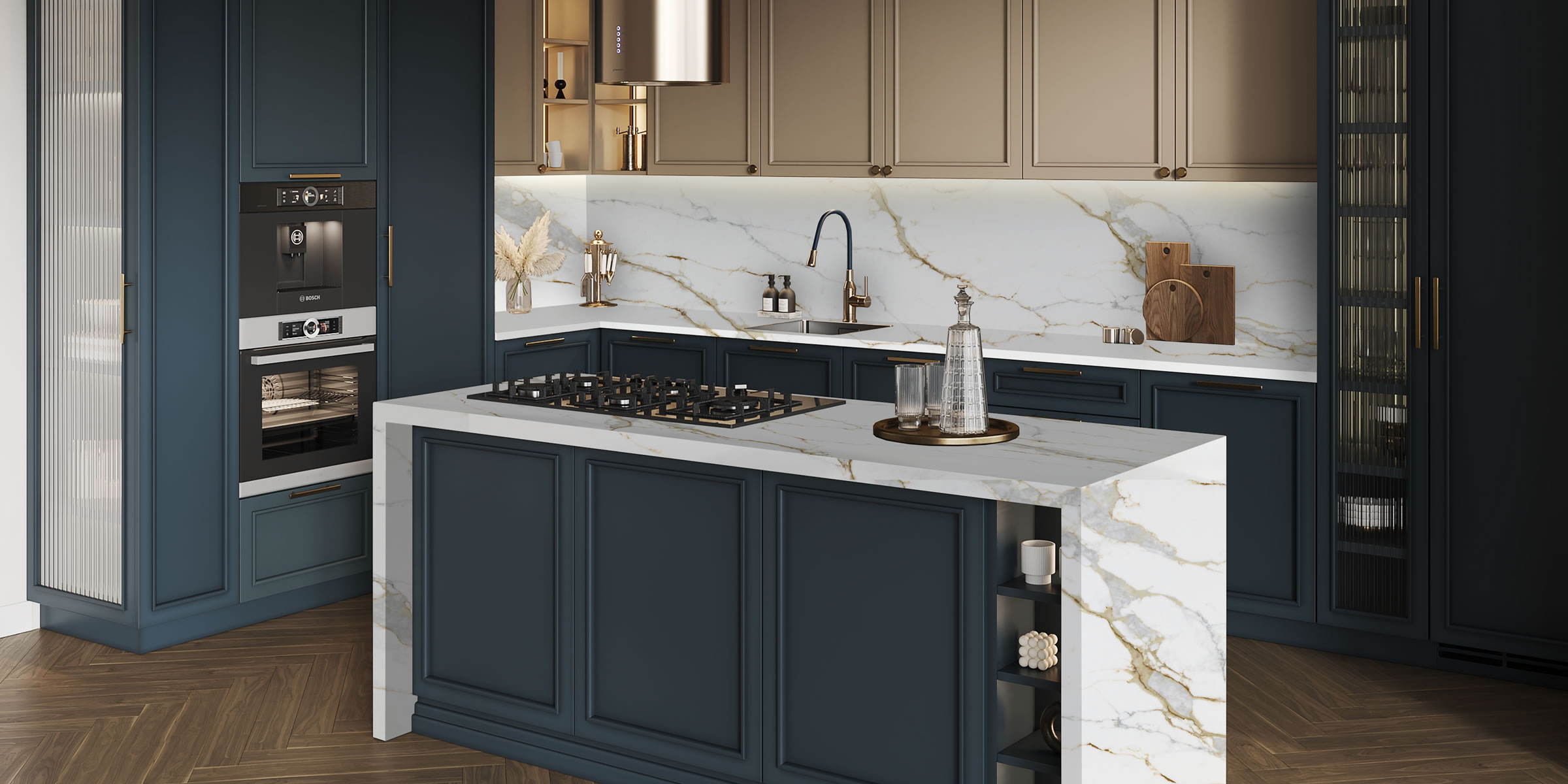

You find a kitchen photo with soft, natural-looking veining, then notice the material is listed as printed quartz. What exactly is printed—and what will the countertop look like once it is cut for your room?
Those are useful questions. Printed quartz countertops bring digital imaging to an engineered surface, but the picture is only part of the decision. The exposed edge, the finish and the way each piece meets the next deserve just as much attention. Here is how to look at Venezia Surfaces’ collection with those details in mind.
Engineered quartz with a digitally applied surface design.
Review a current sample, the full slab and a finished edge.
Confirm the exact design, finish and fabrication plan.
What is printed quartz?
Venezia describes printed quartz as an engineered quartz slab enhanced with high-definition digital printing. A quartz-and-resin base provides the slab; a digitally applied design creates the stone-inspired appearance on its face. In its explanation of the manufacturing process, Venezia outlines surface preparation, inkjet printing, curing and finishing.
Engineered base
Quartz and resin are formed into a slab that supports the finished surface.
Digital design
A controlled printing process adds the color and stone-inspired pattern to the face.
Finished surface
Curing and finishing complete the surface. Check the specifications for your exact selection.
This is a simplified explanation, not a specification for every product. Printing allows detailed control over the face design. It does not, by itself, tell you how the pattern appears through the thickness or how two cut pieces will align.
Printed quartz, traditional quartz or quartzite?
Similar-looking slabs can be very different materials. Use the material description—not the color name—to understand what you are buying.
| Surface | Where the look comes from | What to review |
|---|---|---|
| Printed quartz | An engineered quartz base with a digitally applied face design. | The printed face, exposed edge, finish and layout of adjoining pieces. |
| Conventional engineered quartz | A manufactured composition and pattern; production methods vary. | The actual slab, pattern scale, edge appearance and product care instructions. |
| Natural quartzite | Natural stone with mineral variation formed in the earth. | The individual slabs, fissures, fabrication requirements and stone-specific care. |
If you are deciding between the two stone looks, compare the selected printed design with an actual quartzite slab. A similar photograph does not make the materials interchangeable.
Look beyond the small sample
Start with the background color. Then step back and look at the movement across the entire slab. A fine vein that feels quiet in a sample can create a strong diagonal once it stretches across an island.
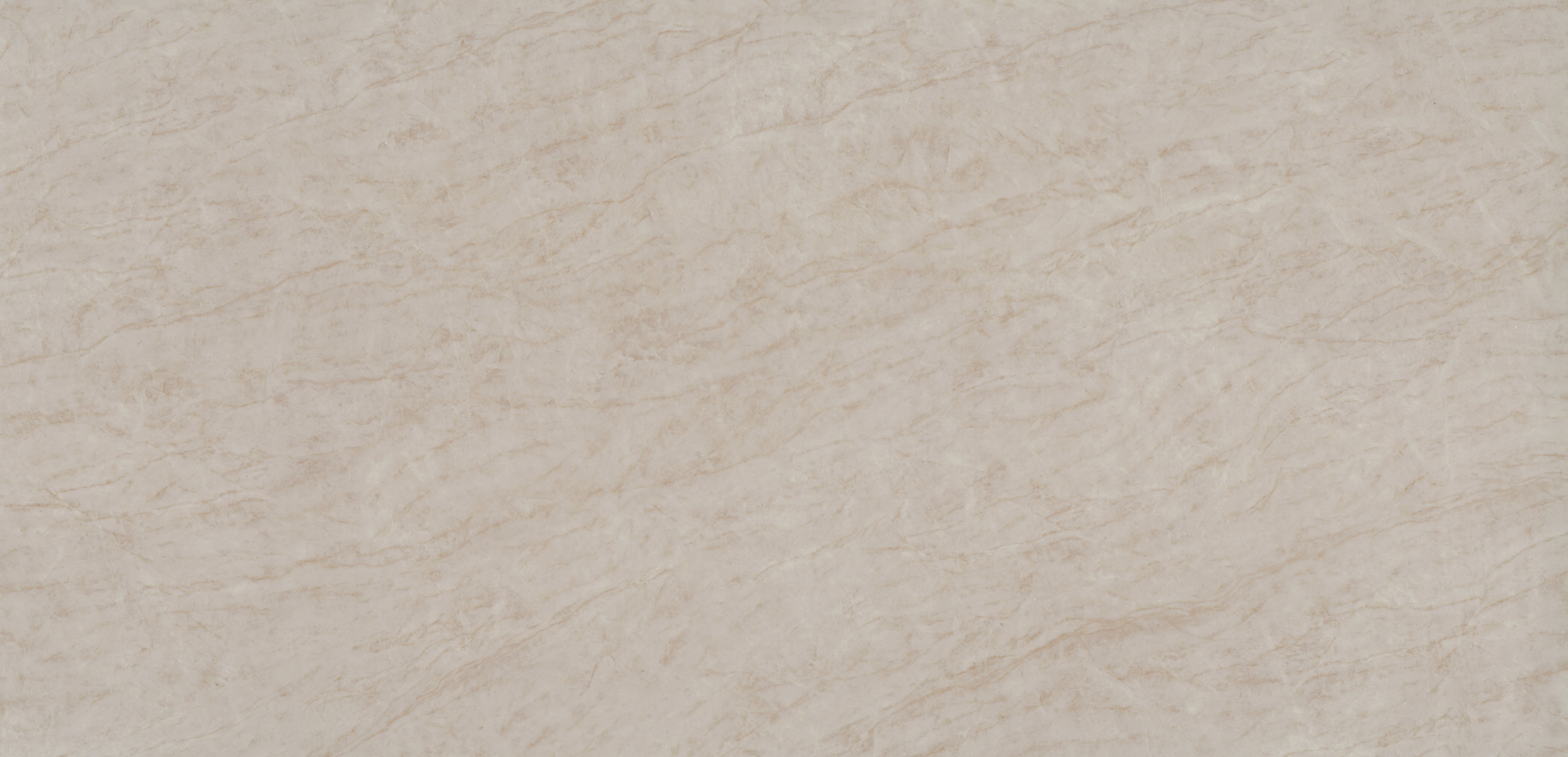
Royal Taj Quartz
Warm neutral tones and gentle movement make this a useful starting point if you like a softer stone look. Place a cabinet sample beside it: creamy white, bright white and natural wood can each change how the background reads.
Venezia includes this design in its printed quartz range. Review the current slab and finish before making your final selection.

Taj Blanc PSJQ Quartz
This lighter option has a soft white background and fine beige and pale gray veins. It is worth comparing if you want understated movement rather than a bold, high-contrast pattern.
Look at it under your room’s lighting and beside your backsplash. Ask which finish is being quoted; a color name alone does not settle that detail.
Keep the full collection handy
Browse the Venezia Surfaces color catalog at Granite System to open individual portfolio pages. You can also explore the manufacturer’s printed quartz catalog. Our broader Venezia collection includes different material types, so check the description of each selection. A catalog listing does not confirm live stock.
The details a kitchen photo cannot answer
A room image is helpful for mood and proportion. For the fabrication decisions, ask to see the surface up close. These four conversations can prevent surprises.
1. See the exposed edge
Ask how the design looks on a straight polished edge and around a sink opening. Do not assume that a printed face continues through the slab’s full thickness. A finished sample is more useful than an explanation alone.
2. Review a mitered corner
If you want a thicker-looking edge or waterfall panel, review how the face pattern will meet at the corner. Discuss the cut direction and the joint. A dramatic vein needs a deliberate layout.
3. Approve the seam plan
Ask where the seams will go and what happens to the pattern on either side. Digital printing does not make every joint disappear. Our countertop seam guide explains the planning questions.
4. Confirm the usable slab
“Jumbo” is a product description, not a promise that your island will fit in one piece. Have the fabricator check the actual dimensions, usable area, cutouts, handling route and support requirements.
For a countertop and full-height backsplash, ask to see both on the same layout. It is easier to move a vein on a drawing than to reconsider it after fabrication.
Everyday care: keep it simple
Venezia’s quartz maintenance guidance recommends mild dish soap or a suitable pH-balanced cleaner, warm water and a soft cloth or nonabrasive sponge. Rinse away residue and dry the surface.
- Use a trivet. Keep hot pans and heat-producing appliances off the surface unless the product’s instructions specifically allow the setup.
- Choose cleaners carefully. Avoid bleach, oven cleaners and abrasive products. Check a wipe’s ingredients and the exact surface instructions before using it.
- Use a cutting board. Treat the countertop as a finished surface, not a chopping board.
- Check the application. Do not assume an indoor quartz selection is approved for an outdoor kitchen or prolonged sunlight exposure.
Follow the care sheet for the exact printed product and finish you order. A general quartz claim is not a substitute for those instructions.
What should your estimate include?
Compare more than the slab name. Send your preferred portfolio link, rough measurements, a few room photos and any backsplash or waterfall plans. Ask for the quote to identify the selected material and finish, edge profile, cutouts, seam layout and installation scope.
Venezia supplies surfaces; Granite System handles your countertop fabrication and installation project. Confirm availability and any applicable written warranties before ordering. For an initial planning step, try our countertop price calculator, then request a quote based on your actual space.
A few things worth clearing up
Is printed quartz natural stone?
It is an engineered surface. A natural-stone-inspired print does not turn it into marble or quartzite.
Are all Venezia surfaces printed quartz?
No. Check the material on the individual product listing. The brand’s broader selection includes other surface types.
Does the vein go all the way through?
Do not judge that from the face image. Ask to see the actual product’s cut edge and a finished edge sample. Printing on the face alone does not establish a through-body pattern.
Will printed quartz countertops be completely seamless?
No product name guarantees that. The room dimensions, slab size, access, cutouts and fabrication plan determine whether a seam is needed and where it belongs.
Can I choose from a photo?
Use photos to narrow your choices, then review a physical sample and the current slab. Lighting, screen settings and image editing can affect the color you see.
Found a look you can imagine at home?
Choose a few favorites from the Venezia catalog and send us their portfolio links. We will help you compare the surfaces and plan the edges, seams and installation for your kitchen or bathroom in Northern Virginia, Maryland or DC.
Visit our Chantilly showroom with cabinet samples or project photos. Please call before visiting.
Sources & image notes. Reviewed November 14, 2026. Technical references: Venezia’s printed quartz explanation, printed quartz catalog, maintenance recommendations and quartz FAQ. Logo and design references: Venezia Surfaces. Manufacturer imagery illustrates the designs and does not document a Granite System installation.