
A dark granite slab can look crisp and reflective in one finish, then quieter and more tactile in another. That is why choosing leathered granite countertops is about more than preferring a matte photograph. The surface will change how light, touch and everyday marks read in your kitchen.
Start with the actual stone, then compare the finishes available for it. A leathered sample from one granite cannot reliably predict the texture of another. Here is what polished, honed and leathered mean—and how to make the comparison useful.
What is leathered granite?
A leathered finish uses abrasive brushes to create a textured surface with a mix of relief and sheen. The Natural Stone Institute’s educational site describes a finish that can feel uneven but soft; the result varies with the stone.
Polished granite is worked to a glossy, reflective surface. Honed granite is smooth with a low-sheen appearance. Honed and leathered are therefore different choices: both may look quieter than a polish, but one is smooth and the other has texture.
| Finish | What you see and feel | What to check in person |
|---|---|---|
| Polished | Smooth, glossy and reflective. | Window and pendant reflections, color depth and how everyday marks appear. |
| Honed | Smooth with a softer, low-sheen appearance. | The exact tone, touch and visibility of fingerprints or water marks. |
| Leathered | Textured, with relief and varying levels of sheen. | The depth of the texture and how easily the sample wipes clean. |
The label alone is not a complete specification. Ask to see the finish offered for the slab you are buying, including the edge. A particularly textured sample may feel very different from another supplier’s interpretation of the same finish name.
How does the finish change the room?
A reflective countertop can pick up windows, lighting and nearby colors. A less glossy surface can shift attention toward the stone’s grain and the room’s other textures. Neither effect is automatically more modern or more suitable for every kitchen.
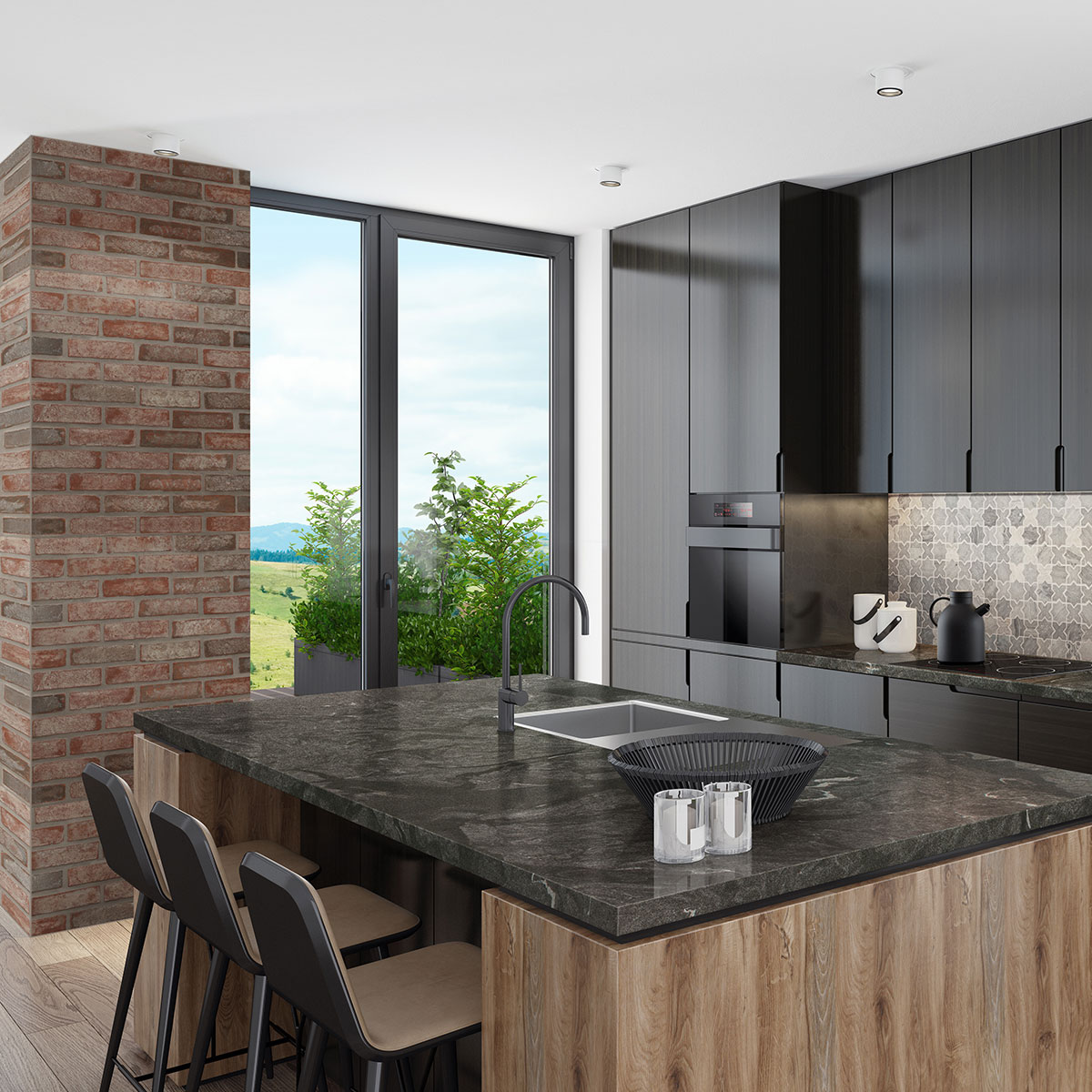

With wood cabinetry
Look at the grain in both surfaces. A textured countertop and strongly grained cabinets can create a layered room, but you may want a simpler backsplash to give your eye somewhere to rest.
With dark painted cabinets
Check the samples after dark as well as in daylight. The countertop needs to relate to the cabinet without disappearing into the same block of color. Lighting placement can change that relationship.
With a large window or bright pendants
Stand where you normally prepare food and sit at the island. Tilt a polished sample toward the light, then compare the other finishes from the same positions. Photographs often hide the glare you would notice in person.
Use the Granite System granite collection to shortlist colors, then ask which finishes are currently available. The gallery is not a promise that every stone can be supplied in every finish.
Is leathered granite easier to maintain?
It depends on the stone, the depth of texture, the treatment and how the kitchen is used. A textured surface may make some everyday marks less obvious, while its low areas can take more attention to clean. Do not turn “hides a fingerprint” into “never needs cleaning.”
For routine natural-stone care, the Natural Stone Institute recommends a neutral cleaner, stone soap or mild liquid dishwashing detergent with warm water, followed by rinsing and drying. Avoid abrasive products and cleaners that are unsuitable for the selected stone. Use cutting boards and trivets.
Does every granite need annual sealing?
No fixed schedule applies to every slab. The Natural Stone Institute notes that many granites do not need sealing, while others benefit from it. The stone’s absorption and existing treatment matter. Ask the fabricator which sealer, if any, is appropriate and how to assess when it needs attention.
A penetrating sealer can reduce absorption; it does not turn the stone into an indestructible surface. Choosing a leathered finish does not, by itself, settle the sealing question.
A useful sample test before you decide
- Use the same stone where possible. Compare finishes on matching material rather than comparing a polished light granite with an unrelated dark leathered one.
- Bring the cabinet sample. Include flooring and backsplash materials so the finish is part of the whole palette.
- Check both kinds of light. Review daylight and your intended task lighting.
- Feel the texture. Run your hand over the sample and look at it from a low angle.
- Review an edge. Ask how the edge profile will be finished and how it will meet the top.
- Discuss a cleaning demonstration. Have the supplier show the recommended routine on a sample, using products approved for that stone and treatment.
If you love the color but dislike the offered texture, keep looking. You do not have to accept a finish that feels wrong simply because the slab name is familiar.
What should the quote identify?
List the actual stone and slab selection, finish, thickness and edge. Ask whether the requested finish affects availability, fabrication or the final estimate; do not assume one finish always costs more.
The layout still needs attention. Review seam positions, cutouts, supports and usable slab area before fabrication. Our countertop seam guide explains the questions, and the price calculator can help start a project conversation.
Let’s compare a finish sample with your room.
Send your preferred granite portfolio link, cabinet photos and rough measurements. Granite System can help plan fabrication and installation across Northern Virginia, Maryland and DC.
Please call before visiting our Chantilly showroom.
Sources & image notes. Reviewed November 14, 2026. Technical references: Natural Stone Institute’s stone care guidance and sealing statement; Use Natural Stone’s finish overview and textured-surface discussion. Images are stone and room design references, not documentation of a Granite System installation or matched finish test. Natural color and texture vary by slab.