
Natural Stone Guide · DC · Maryland · Northern Virginia
Quartzite, without the showroom confusion.
Quartzite can deliver the soft movement people love in marble with the hardness expected from a serious natural-stone work surface. The key is knowing what genuine quartzite is, how individual slabs differ, and what to check before fabrication.

Quartzite is one of the most misunderstood countertop materials in the showroom. The name sounds like quartz, many light varieties resemble marble, and trade labels are not always reliable geological descriptions. For a homeowner, those distinctions matter because they affect how the surface wears, how it reacts to acids, how it should be maintained, and what questions to ask before a slab is cut.
What is quartzite?
Quartzite is a natural metamorphic rock formed when quartz-rich sandstone is changed by heat and pressure. During that process, the original sand grains recrystallize into a dense network dominated by quartz. The Natural Stone Institute describes quartzite as exceptionally strong, dense and hard compared with many other dimension stones.
That also explains why quartzite and quartz countertops are not the same product. Quartzite comes from a natural slab. Engineered quartz is manufactured from mineral material, binders and pigments. Both can be excellent countertop choices, but they should not be sold, specified or maintained as though they are interchangeable.
What makes quartzite attractive for a kitchen?
For many homeowners, quartzite’s appeal is the combination of natural movement and durability. Some varieties are quiet and creamy; others are highly directional, colorful or dramatic. Unlike a printed pattern, the movement continues through a one-of-a-kind slab and becomes part of the layout decisions made during fabrication.
- High hardness: genuine quartzite is quartz-rich and difficult to scratch in normal kitchen use. Cutting boards are still a smart habit, in part because very hard stone can dull knife edges.
- Good resistance to common food acids: true quartzite does not behave like calcite-rich marble when exposed to ordinary kitchen acids such as lemon juice or vinegar. Strong specialty chemicals can still damage siliceous stone, so harsh acidic cleaners should be avoided.
- Natural heat tolerance: natural stone handles heat well, but trivets remain sensible because rapid, localized temperature changes can stress a countertop or anything used with it.
- Wide visual range: quartzite can move from soft ivory and taupe to blue, green, black, rust and gold depending on the minerals present.
- Each slab is individual: vein direction, color temperature, fissures and pattern scale vary. That variability is an advantage when it is planned rather than treated as a defect.
Three quartzites, three very different design personalities
The easiest way to understand quartzite’s range is to compare actual stones rather than describe the category as if it has one look.
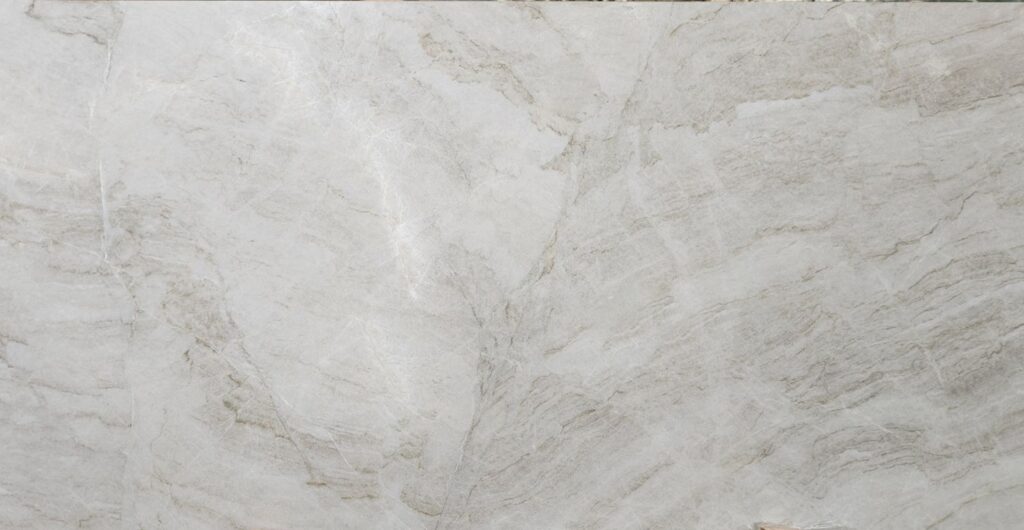
Taj Mahal Quartzite is known for a warm ivory-to-beige field with restrained taupe and gold movement. It works especially well when a kitchen needs warmth without a busy pattern. Use Natural Stone also cites Taj Mahal as an example of a highly metamorphosed quartzite with tightly bonded minerals, though sealing decisions should still be based on the actual slab and its porosity.
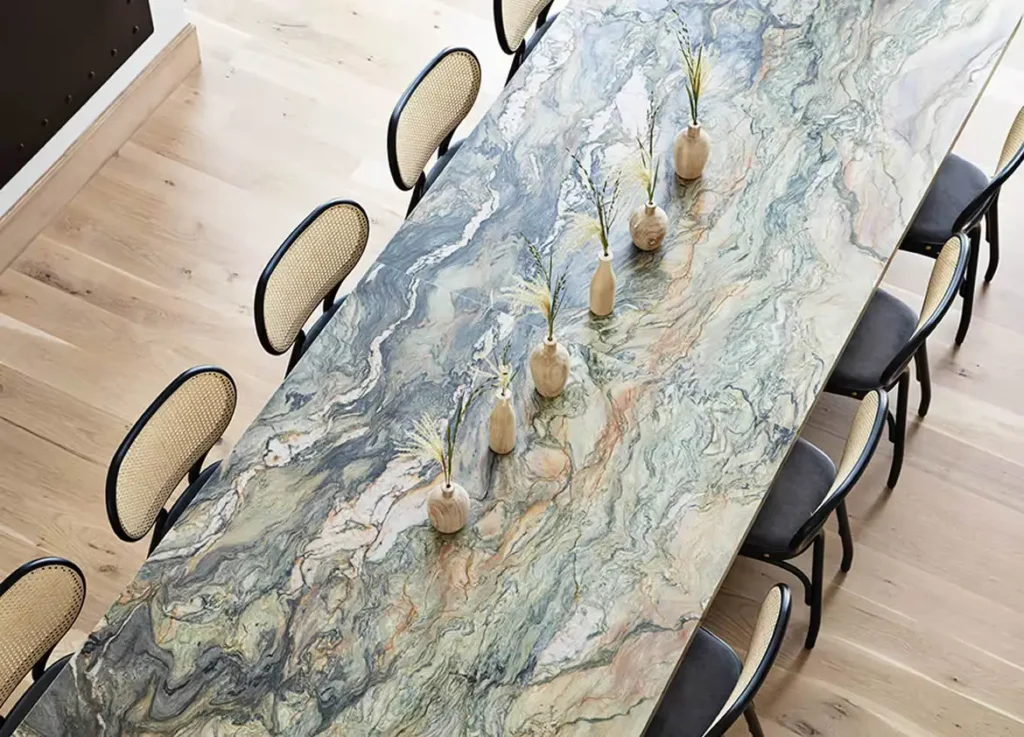
Fusion Blue Quartzite shows the opposite side of the category. Its movement is much more expressive, making the stone itself a major design element. On an island or a large uninterrupted run, fabrication layout becomes critical because rotating the slab or changing seam placement can completely change the visual flow.
Belvedere Quartzite demonstrates that quartzite is not limited to pale, marble-like surfaces. Its dark field and contrasting gold-toned movement can create a much stronger architectural statement. In a kitchen like this, cabinet color, backsplash restraint and lighting become part of the stone-selection decision rather than afterthoughts.
Quartzite vs. marble vs. granite
| Feature | Quartzite | Marble | Granite |
|---|---|---|---|
| Geology | Metamorphosed quartz-rich sandstone | Metamorphosed carbonate stone | Igneous rock |
| Typical visual character | Crystalline; can be quiet, flowing or dramatic | Classic veining and softer visual depth | Very broad range; often mineral-rich or granular |
| Scratch resistance | High for genuine quartzite | Lower | Generally high |
| Common food-acid etching | True quartzite is resistant | Expected with acidic spills | Generally resistant, though mineral composition varies |
| Sealing | Depends on porosity and sealer performance | Commonly used for stain resistance | Depends on the specific stone |
There is no universal winner among these three materials. Marble is appropriate for homeowners who value its appearance and are comfortable with etching and patina. Granite offers an enormous range of colors and patterns with strong durability. Quartzite is particularly compelling when the goal is a hard natural stone with flowing movement and better resistance to ordinary food-acid etching than marble.
The quartzite label deserves a second look
One of the most useful things a buyer can know is that a showroom name is not always a geological guarantee. Stones marketed as “soft quartzite” may actually be marble or dolomitic marble. That matters because an acid-sensitive stone can etch even when the buyer expected quartzite performance.
True quartzite is hard enough to scratch glass and is difficult to scratch with a knife blade. It also should not etch from ordinary kitchen acids such as lemon juice or vinegar. Testing should be done on an appropriate sample or with guidance from the stone supplier or fabricator rather than experimenting on a finished countertop.
Does quartzite need sealing?
Sometimes. Quartzite is not one uniform product, and porosity can differ from one variety to another. An impregnating sealer does not make stone stain-proof; it reduces the rate at which liquids can enter the surface and improves stain resistance. The Natural Stone Institute recommends choosing sealer type and frequency with the stone supplier or sealer manufacturer rather than assuming every natural stone needs the same schedule.
A practical clue is water darkening around a heavily used sink area. If clean water begins to absorb and temporarily darken the stone more readily than before, the sealer may need evaluation. The important distinction is that sealing addresses staining, not etching.
Everyday quartzite care
- Clean with a soft cloth or sponge, warm water and a mild soap or pH-neutral stone cleaner.
- Blot or wipe spills promptly instead of leaving liquids on the surface for long periods.
- Use cutting boards even though genuine quartzite is hard.
- Use trivets or mats for very hot cookware.
- Avoid abrasive powders and harsh acidic cleaners unless specifically approved for the stone and its finish.
For a broader maintenance routine, see our Quartz, Granite & Quartzite Maintenance Guide for DMV Homes.
Polished, honed or leathered?
Finish changes more than shine. A polished finish emphasizes color depth and crystal structure. Honed stone reflects less light and can make a pale quartzite feel softer and more architectural. Textured or leathered finishes add tactile character, although the texture can require more attention when wiping residue from the surface.
The same slab can read differently under showroom lighting, daylight and warm residential lighting. Viewing finish samples next to cabinet and flooring materials is more useful than choosing from a screen alone.
What should you inspect before fabrication?
- View the full slab. A small sample cannot reveal the composition of a large island.
- Look at slabs together. If the project needs more than one slab, compare color and movement side by side.
- Plan vein direction. Decide how movement should run across the island, sink run, waterfall edge or full-height backsplash.
- Discuss seams before cutting. Ask where seams are likely to land and how the adjoining movement will relate.
- Understand natural fissures. Natural stone can contain fissures and mineral features. Ask the fabricator which are normal characteristics and which require structural attention.
- Confirm edge and sink details. Quartzite’s hardness can make fabrication more demanding, so complex edges and cutouts should be planned deliberately.
- Ask about the actual slab’s porosity. Do not set a sealing schedule based only on the word “quartzite.”
Is quartzite right for your kitchen?
Quartzite is a strong fit for homeowners who want genuine natural stone, appreciate variation from slab to slab, need a hard work surface, and prefer natural movement over perfectly repeated patterning. It is less suited to someone who wants every installed section to look identical or who does not want to discuss any natural-stone maintenance at all.
For projects in Washington DC, Maryland and Northern Virginia, the best next step is to compare full slabs and discuss layout before fabrication begins. Browse Granite System’s Quartzite Collection or review our Quartzite Countertops page for fabrication and installation information.
Considering Taj Mahal, Fusion or Belvedere?
Bring cabinet colors, flooring samples and backsplash ideas when you view slabs. Granite System can help you evaluate the stone, plan vein direction, review seam placement and coordinate fabrication details so the finished countertop makes sense as a complete kitchen—not just as a beautiful slab.